Saturday, May 2, 2015

Exit Interview

(1) What is your essential question, and what are your answers?  What is your best answer and why?

My essential question is "What is the best way to maximize a visitors' experience at an aircraft or science museum?"
My Answer 1 is "You must be able to effectively balance between communication and knowledge so as to speak with confidence and helpfulness when confronting a guest."
My Answer 2 is "An effective management structure based around the museum's goals/mission must be in place to deal with any situations."
My Answer 3 is "A volunteer program that allows its volunteers to utilize their individual skills."

My best answer is Answer 1. The reason being is that a museum is considered to be a house, source, and provider of knowledge. If a museum's staff are not capable of delivering information to a guest and accomplishing a museum's most necessary function, then a museum becomes nothing more than a place full of pointless artifacts and lost its purpose.

(2) What process did you take to arrive at this answer?

The process I took to arriving at this answer was to first establish what my three answers are, then to prioritize the answers based on its necessity and practicality in a museum. I concluded that no matter how good a management program is or how much skills a volunteer has, it means nothing if they don't know anything about the environment in which they work in and the type of people they encounter.

(3) What problems did you face?  How did you resolve them?

A problem that I faced with my Senior Project was my lack of knowledge on certain topics. Whenever I work at the California Science Center and Planes of Fame, there arises certain situations in which I wasn't able to answer a visitor's questions because I did not know it such as the features of a plane I was cleaning. To resolve these issues, I take note of what I do not know now and spend time outside of working reading articles that focus primarily on topic. I read topic characteristics such as reading a communications article to better approach people or to read a NASA article to inform guests about the space shuttle program. If a similar situation were to arise, then I am now better prepared.

(4) What are the two most significant sources you used to answer your essential question and why?


My most significant sources are my mentorships at the Planes of Fame Air Museum and the California Science Center. Working at these museums have allowed me to come with up answers, based on similar scenarios I encountered between the two, which would be later confirmed by reading articles published by various museums, institutions, directors, and managers.

Monday, April 27, 2015

Monthly Blog Assignment April: The Big Red One is Coming

 Hello, everyone. Benny here. Similar to my previous monthly posts, I'll be going over my initial thoughts and observations from whatever specific events(s) I came across. This month's post is pretty much about a question that I usually ask people to define. Once again, if you want a more descriptive paragraph about my mentorship duties, please refer to my Mentorship Log. Other than that, let's get started.


Well in a couple of days, Planes of Fame Air Museum is going to have its annual airshow. 30,000 guests estimate, millions of dollars of planes, history living in front of you, one of a kind planes taking flight, and I'm somewhere in the middle of it all.

Am I nervous? Maybe. But I'm pretty excited to get to see dozens of historical planes all fly up at the exact same time. Heck yeah. Museums are fine and all I've seen many of them, but when a museum does something as grand as this, the things you can find are incredible and in the moments you experience, you know that this Planes of Fame is no ordinary museum. Plus, I get to see some of the planes I worked on fly.


Got my volunteer shirt. Need some sunblock and a fully charged phone.

Enough blogging. Let's do this.

LEEROY JENKINS!!!

Sunday, April 26, 2015

Independent Component 2

LITERAL
(a) Include this statement: “I, Benedict Paz, affirm that I completed my independent component which represents 31 hours of work.”


I, Benedict Paz, affirm that I completed my independent component which represents 31 hours and 50 minutes of work.

(b) Cite your source regarding who or what article or book helped you complete the independent component.

My fellow volunteers for giving me the idea and encouragement to do this project.
The Endeavor Volunteers for helping work on the project.
Mrs. Stephanie for allowing me to do the project.

(c) Update your Independent Component 2 Log (which should be under your Senior Project Hours link)

It has been updated.

(d) Explain what you completed.    


This project is still ongoing, but the project was to help the experience of other volunteers and to gain some insight into their thoughts. The idea of this project was to help create an answer to my EQ. The work that I have done has led me to my Answer 3, A volunteer program that allows its volunteers to utilize their individual skills. This was formed from my experiences talking with my fellow volunteers. Though they come from all walks of life, their variety of reasons for volunteering at the California Science Center and what differentiates them from a paid employee has a notable effect on the experience of a visitor. Currently, I am working on a project to acquire information for tablets allocated for the Endeavor Volunteers at the request of both Mrs. Stephanie and the Endeavor Volunteers. Doing this is a way of helping the volunteers at the Endeavor exhibit who feel that they aren't able to utilize the resources allocated to them by the museum to help the visitors.

INTERPRETIVE 
Defend your work and explain the component's significance and how it demonstrates 30 hours of work.   
Provide evidence (photos, transcript, art work, videos, etc) of the 30 hours of work. 


Some of my work, such as the notes I took with fellow volunteers and my initial research have already been submitted and I no longer have access to them. Here are some of the pictures I was able to take:

Notes I took of the various sites I researched

Notes I took of the various sites I researched

A volunteer party organized by Mrs. Mayra (shown above) was one of many opportunities I had to talk to volunteers.
One of the apps requested by the Endeavor volunteers to be put into the tablets.


APPLIED
How did the component help you answer your EQ? Please include specific examples to illustrate how it helped. 

Independent Component 2 helped reaffirm my thoughts I had about my Finding 3,
. By using my temporary freedom from my normal duties, I was able to make connections with volunteers outside my work zone and to gain some thoughts and insight as to why they choose to work at their respective zones and why they are happy to work. This goes with the idea, that by allowing a volunteer to work where their skills are best suited, it would give them more incentive to work which in turn, benefits the visitors' experience.


Tuesday, March 31, 2015

Monthly Blog Assignment March: The Mental Museum

Hello, everyone. Benny here. Similar to my previous monthly posts, I'll be going over my initial thoughts and observations from whatever specific events(s) I came across. This month's post is pretty much about a question that I usually ask people to define. Once again, if you want a more descriptive paragraph about my mentorship duties, please refer to my Mentorship Log. Other than that, let's get started.

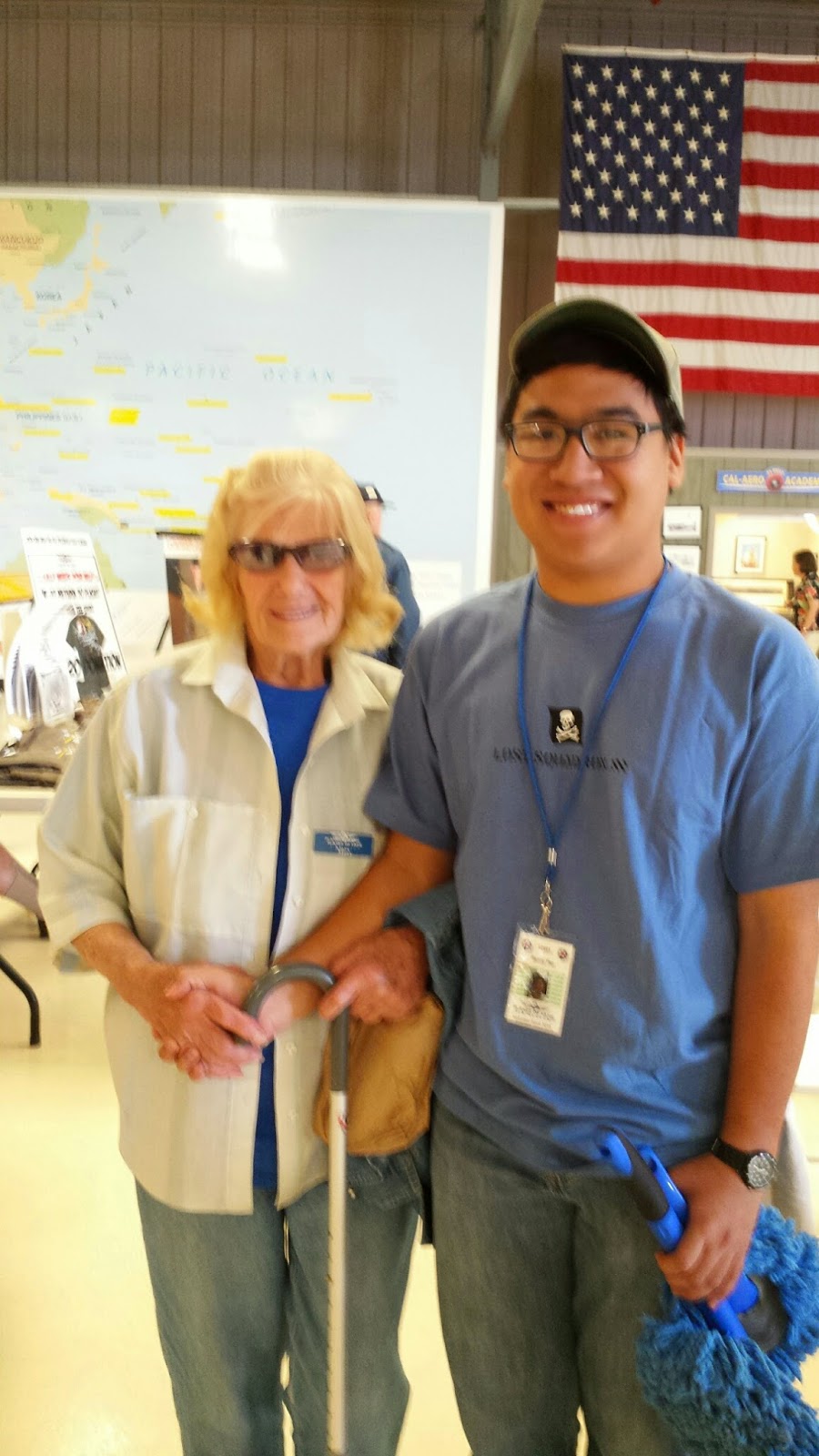
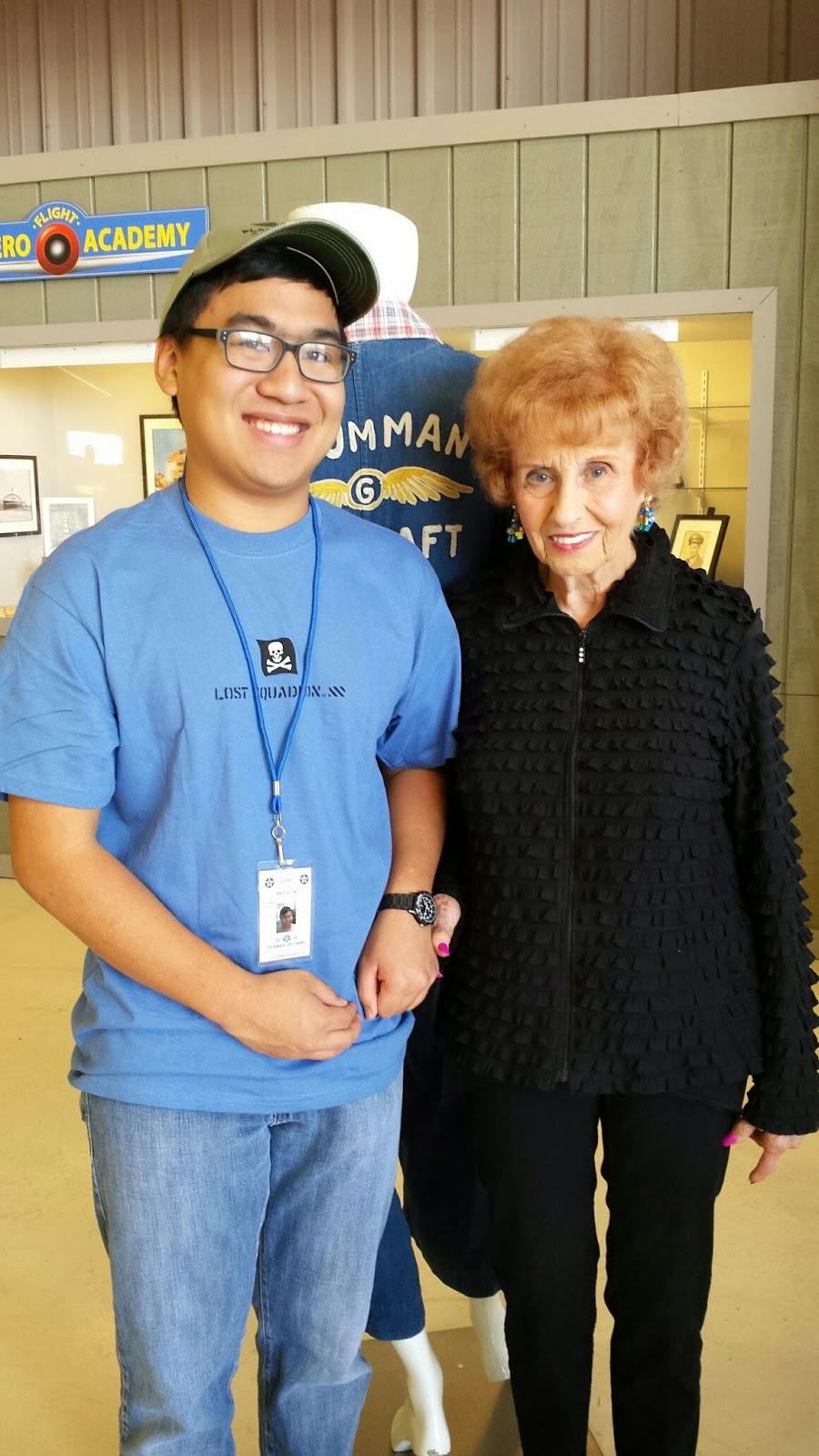
The idea of the museum is often associated with a physical place that echoes of the memories behind it, but what if that museum is not a physical place, but a person. A couple of days ago, the idea of the museum was challenged when we had three guest speakers at Planes of Fame during living history month in honor of Women’s History Month. Mary, one of our volunteers at the gift shop, who talked about how she built airplanes in England during the Blitz. Elinor Otto a “Rossie the riveter” who worked at Boeing for 49.5 years and was forced to retire from Boeing a couple months ago at age 95. Iris Cummings Critchell, one of the members of the original 99 club, an Olympic  swimmer at the 1936 Summer Olympic Games, and a civilian ferry pilot for the Army Air Corps.

All three of them spoke about their lives with such detail that shocked me when compared to the various male speakers who were much younger in comparison. After the talk, I was able to talk to Iris, about her experiences. I was previously told that she competed in the 1936 Summer Olympic Games in Berlin, Nazi Germany. When analyzed from the present, the 1936 Summer Olympics is known primarily for two things Jesse Owens and Nazis, along with various other famous Olympic events. During the Q&A after the talk, I noticed that the audience would ask Iris if she witnessed famous Olympic events, which greatly annoyed her as the audience forget the fact that:

A: SHE COMPETED IN THE OLYMPICS!!! WHY ARE YOU ASKING HER ABOUT OTHER PEOPLE!!! ASK ME!!!

B: Some of these events were impossible for her to have witnessed given the situation she was in.

Rather than do what the audience did, I just asked her what it was like to compete in the Olympics. When I asked her that her response was completely different from when she talked to the audience. Her mood changed rapidly, reminiscing about all the great moments he she had with her fellow Americans and female athletes from other nations, talking about how her father worked on the 1896 reincarnation of the Olympic Games and how that, along with seeing the 1932 Summer Olympic Games in Los Angeles inspired her to train for the Olympics, entering the stadium and seeing the thousands amongst the crowd. She had a sparkle in her eye, a different one from the one during the talk. Her eyes looked like she was once again taking part in an event that happened decades ago right in the present and telling me what she sees through those eyes. When I look back, I think about how not even a physical museum can house the various life experiences she had. And when I consider the experience I had with her and the many others I had with other people, maybe a museum is not just a physical place, but a mental one as well.  Though I may not have access to her museum, I at least took away with me a part of it.

Well that’s the end of my blog here. Enjoy my little reflection and enjoy the rest of Women’s History Month. Until next time, take care everyone.

- See You Space Cowboy...

Mary

Elinor Otto

Iris Cummings Critchell


Wednesday, March 11, 2015

Fourth Interview Questions: Update

These will be my 20 or so new questions for Mr. Ed Maloney. Questions and number of questions asked will be subject to change:

If you were to give a message to your younger self, what would it be?
When did you start collecting airplanes?
Why did you start collecting airplanes?
What do you think of when a plane is added to the museum?
Did you picture your plane collecting to grow to this scale 60 years ago?

Volunteers
What do you define volunteering as?
What does any volunteer need to have?
What roles does volunteering have at your museum?
How has volunteering changed over the years?
How has the communication worked? What didn’t?
Why do you think people volunteer?

Skills
What skills are required to volunteer at Planes of Fame?
What kind of freedom does Planes of Fame give to volunteers in utilizing outside skills?
How does Planes of Fame allow volunteers to utilize outside skills?

Management
What do you define volunteer management as?
How does Planes of Fame choose to manage its volunteers?
What should the relationship between managers and volunteers be?
What do you perceive the relationship is between managers and volunteers?

Museum Message
What is Planes of Fame’s message/quota/motto?
How has Planes of Fame communicated that message over the years?

Visitors
How has your collection affected your visitor’s experience?
How have you communicated with guests over years?
How has Planes of Fame chosen to communicate with its guests?
How have visitors at your museum changed over the years?
How have you adjusted to those changes?
What is your biggest challenge when working with visitors?

Monday, March 9, 2015

Fourth Interview Questions

For my 4th interview. I will be interviewing Mr. Edward T. Maloney. Edward T. Maloney is known to one of the forerunners of the modern airplane museum, developing air museum concepts and principals that would be widely imitated by every airplane museum since then.

During the post-war 50's when all war material was being scrapped, Edward T. Maloney, after watching famous planes he heard about get destroyed in front of his eyes,  had the foresight to save as many planes as he could for future generations. Today some of the planes he saved ARE THE ONLY ONE OF ITS KIND IN EXISITANCE such as the world's only flyable Mitsubishi A6M5 Zero with its original Sakae engine, a flyable Nakajima Ki-84 which he would loan to the Japanese, one of two original Boeing P-26A Peashooter, the world's only Mitsubishi J8M1 Shusui, a Yokosuka D4Y3 Model 43 Suisei, a Northrop N9MB Flying Wing, an Aichi D3A2 Val that is being restored to flight status, a Mitsubishi J2M Raiden, and from this small list out of 146 planes, you get the picture.

Ed Maloney was also heavily involved in acquiring or displaying aircraft around the world. He has made numerous trips to places such as Guatemala to the Pacific Islands to acquire. In 1970 Ed Maloney brought over his one of a kind flyable Mitsubishi A6M5 Zero with the original Sakae engine, to Japan for tour, the first time a Zero had been on Japanese soil for 35 years. The plane went on tours across Japan, being viewed by 10 million Japanese people. WWII Japanese pilots wept or were amazed to see an airplane they haven't seen in decades. Notable Japanese such as Jiro Horikoshi, designer of the A6M Zero family, and Saburo Sakai, one of Japan's best aces, became friends with Ed from his tour. Even now Ed still likes showing his love for airplanes to foreigners. A couple of years ago when the Mitsubishi company began was restoring a J8M1 Shusui airframe they found a couple decades ago, Ed allowed them to send a team to Planes of Fame to get measurements of his J8M1 Shusui prototype. Last year, he sent his Boeing P-26A Peashooter to Duxford for an airshow, the first time a Peashooter was on European soil in decades, which I saw during my trip there. His planes have been shown on various media such as Pearl Harbor (2001), Tora Tora Tora, Valkyrie, Memphis Bell, etc.

After noticing early plane museums in the 50's left their planes to rot away, Ed Maloney also the foresight to conserve and restore his planes. This foresight have led to extremely well preservation of some his planes, some of which should have rusted away. Since then, many museums have imitated Ed's philosophy from Duxford in the UK to the Smithsonian Institute, but none have done it as better or as thoroughly as Ed Maloney. He's proud of the work he's done and how other museums have followed him in saving aircraft. He can be found wandering the museum on certain days and when you strike a conversation with him, at how much knowledge he has.

For now I will be asking him these questions:

 Job/Field
What was your initial perception of your job prior to working?
What questions are often raised in your job field?
What are the most important aspects of your job?
How does your job help with the guest experience?
Describe your daily duties as the Founder/Director?
How has your job changed adapted over these past few years? How have you adapted to these changes?
What kind of knowledge did you need to learn in this kind of field (museums)?
What kind of skills did you have prior to entering your field? How did those skills help you?
How do you deal with people outside of the museum for work?

Museums
What do you define a museum as?
What sparked the idea to turn your collection into a museum?
What have been your greatest triumphs at the museum?
What about greatest failures?
How has working here changed your perception of museums?

Visitors
Who is this museum for?
Why do you think people continue to go to your museum?
What is the thing you consider the most when dealing with your visitors?
What is the most important aspect about visitors that you focus on.
What was your most memorable experience dealing with a visitor(s)? What did you thought of during this?
How does Planes of Fame engage/interact with its visitors? What are the benefits for the museum and the visitor for using this method? What about disadvantages?

Other Topics
What does Planes of Fame mean to you?
What is it like to work in a facility of this scale?
What is your main goal at the museum?
What drives you to go to work everyday?
If you were to give a message to your younger self, what would it be?
When did you start collecting airplanes?
Why did you start collecting airplanes?
What do you think of when a plane is added to the museum?
Did you picture your plane collecting to grow to this scale 60 years ago?
How has your collection affected the visitors’ experience?

Wednesday, March 4, 2015

Blog 17: Third Answer

EQ
  • What is the best way to maximize a visitors' experience at an aircraft or space museum?

Answer #3 (Write in a complete sentence like a thesis statement)*
  • A volunteer program that allows its volunteers to utilize their individual skills.

3 details to support the answer (a detail is a fact and an example)
  • Volunteers are usually more motivated to work, to teach, and less likely to complain than paid staff.
  • Volunteers sometimes have significantly more knowledge about aircraft or science than paid staff and can be utilized to inform guests.
  • Giving volunteers free reign allows them to experiment with different styles of volunteer engagement than is usually permitted by paid staff.

The research source (s) to support your details and answer
  • Volunteering at Planes of Fame
  • Volunteering at the California Science Center

Concluding Sentence
  • The answer to this question is mostly based off personal experience.